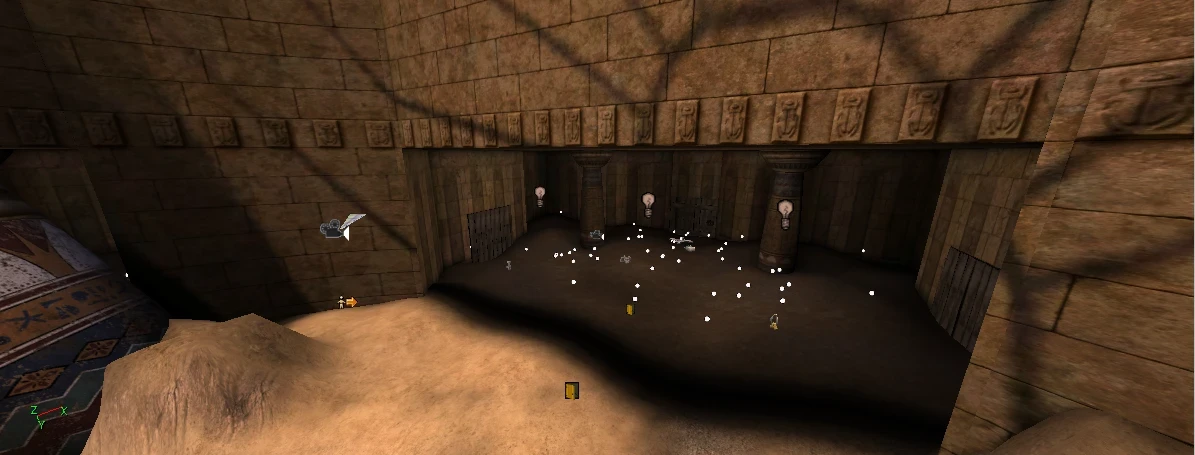
UT2004 Arena Overhaul: Reverse-Engineering Legacy Geometry & Server-Side RPG Systems
This technical level design case study focuses on optimization, spatial geometry reconstruction, and system integration within a legacy 3D engine ecosystem. The project involved refactoring a complex, vertex-baked custom gladiator arena layout (AS-CustomArena_v1) to scale its layout boundaries for advanced wave-defense gameplay mechanics and custom AI pathing requirements.
🛠️ Technical Challenges & Solutions:
Geometry Refactoring: The original layout utilized nested, interlocking custom CSG primitive brushes (starburst/cloverleaf pillars and radiating pie-slice floor segments) that suffered from frozen vertex memory. Standard scaling resulted in severe geometric tearing and BSP world leaks into the void.
Vector Re-Scaling & Order Management: Resolved by isolating the master CSG_Subtract "Pit Maker" brush, expanding its DrawScale3D vector parameters to a uniform 1.25\times footprint, and manipulating the geometry calculation sequence via Order -> To Last. This forced a clean structural cutout without disrupting surrounding entrance corridors or zone boundaries.
System & Objective Portability: Analyzed the local level script architecture (GameObjective and ScriptedSequence nodes). Configured system portability by successfully migrating the map's structural logic framework and event-trigger pipelines into alternative, highly-optimized arena geometries.
Network Replication Debugging: Diagnosed an offline local replication limitation where engine game states failed to pass event triggers down to physical door Mover actors during local editor simulations, optimizing the layout pipeline for dedicated server deployment workflows.